The central idea
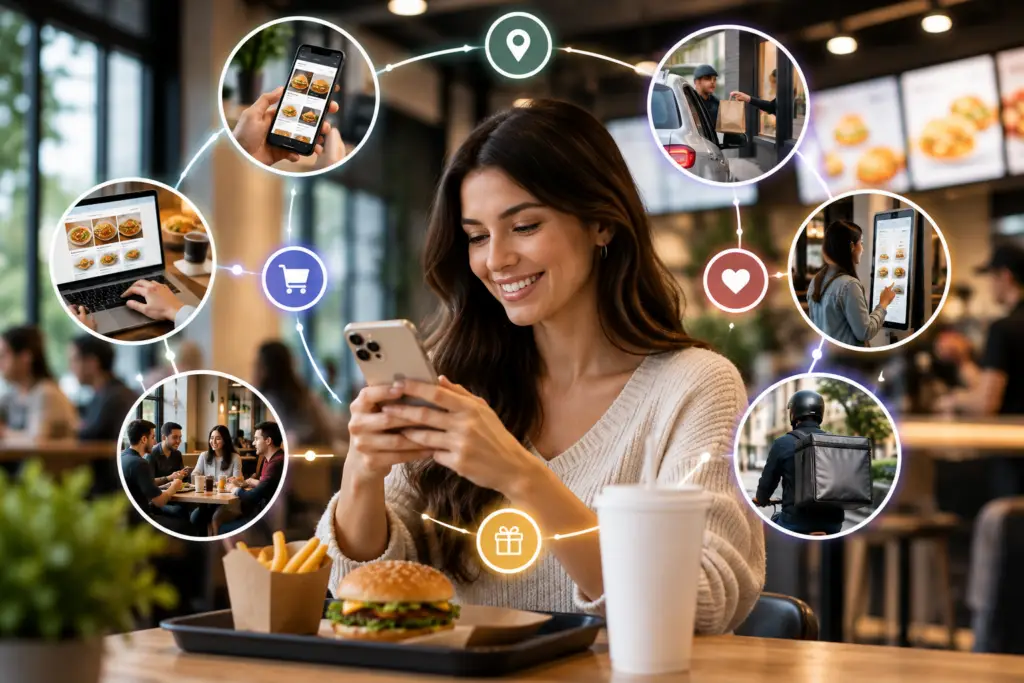
For restaurant brands in the United States and Canada, omnichannel is no longer the destination. Digital ordering, loyalty, delivery, kiosks, drive-thru and other connected touchpoints are already part of the operating environment. The next opportunity is to connect the data those interactions generate—and turn it into customer intelligence that can drive more relevant experiences, stronger engagement and measurable growth.
The next competitive advantage is not adding another channel. It is making every channel smarter.
Table of Contents
ToggleOmnichannel Is No Longer the Destination
For years, restaurant brands invested in building digital convenience: mobile ordering, delivery, kiosks, drive-thru technology, online ordering, apps and loyalty ecosystems. Those capabilities remain important, but they are no longer the strategic endpoint. The more pressing question is what brands do with the customer information created across that ecosystem.
In the US, Deloitte identifies personalized offers at the point of order, ordering suggestions and seamless payment among the digital initiatives restaurant executives see as having significant performance impact. The same research also highlights loyalty as a powerful driver of connection: 77% of restaurant consumers surveyed were more likely to start spending with a brand after enrolling in its loyalty program.
In Canada, loyalty is also becoming an important part of the restaurant value proposition. Restaurants Canada reports that 51% of quick-service restaurants and 29% of full-service restaurants offer loyalty programs, while four in ten Gen Z Canadians use a restaurant app or rewards program to get discounts at QSRs.
The Restaurant Has More Customer Data Than Ever
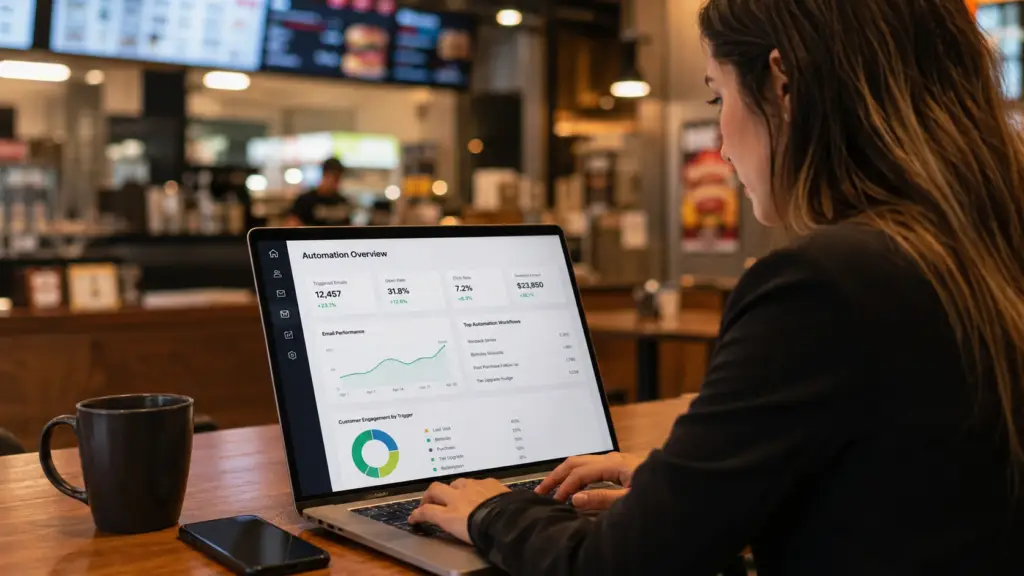
Every interaction can generate a signal about the customer: purchase frequency, recency, average order value, time of day , product affinity, location, channel preference, promotional response, visit cadence and changes in behavior over time.
The challenge is that these signals are often distributed across systems. A transaction may live in a POS, an order may be associated with a digital platform, loyalty activity may sit in a separate database, and campaign engagement may be tracked somewhere else. When those signals remain disconnected, brands can see activity without fully understanding the customer behind it.
The Real Opportunity Is Connecting the Dots
A single transaction can answer what happened. A connected customer history can help explain why it happened—and what might happen next.
When brands connect customer interactions across their ecosystem, patterns begin to emerge. A restaurant may discover that a customer has a high frequency during a particular time of day, a different average order value depending on the occasion, a strong affinity for certain categories, or a measurable response to specific incentives.
These patterns are more valuable than isolated data points because they can become the foundation for commercial decisions.
From Customer Data to Customer Intelligence
Interactions – Data – Patterns – Insights – Segmentation – Personalization – Engagement – Loyalty
The value of an omnichannel strategy can be understood as a progression: interactions create data; connected data reveals patterns; patterns generate insights; insights enable behavioral segmentation; segmentation makes personalization more precise; and personalization can strengthen engagement and loyalty.
Personalization Should Be Contextual, Not Just Individual
Personalization is often reduced to a simple idea: give each customer a different offer. The more sophisticated opportunity is to determine the right action for the right customer in the right context.
A high-frequency customer may be better suited to an offer designed to increase average order value. A customer whose visit frequency is declining may need a reactivation strategy. A guest with strong affinity for a category may respond to a cross-sell recommendation. A value-sensitive customer may respond to a different reward structure.
The same customer does not necessarily need the same message everywhere. Omnichannel intelligence makes it possible to adapt the strategy to the context in which the brand is engaging with the customer.
This is increasingly important because consumers expect more relevant loyalty experiences. Deloitte’s 2025 consumer loyalty research found that 89% of Gen Z and 87% of millennials surveyed were willing to share personal information for more tailored offers or experiences, while 62% of Gen Z and 64% of millennials said they would opt into hyper-personalized loyalty settings for better perks and rewards.
Loyalty as the Activation Layer
Loyalty sits at a powerful intersection between customer identity, behavior and activation. It can provide the mechanism for recognizing a customer, learning from their interactions and giving them a reason to engage again.
That means loyalty should not be viewed only as a rewards ledger. A modern loyalty program can become an intelligence and engagement layer that helps brands translate customer behavior into action.
Deloitte’s restaurant research describes a similar evolution: loyalty programs have traditionally focused on transactional outcomes such as frequency, share of wallet and order value, but brands can move toward experiential engagement through personalized offers, exclusive access and other targeted benefits.
What This Looks Like in Practice
|
Customer signal |
Potential insight |
Potential strategy |
|
High frequency + stable order value |
Strong habit and engagement |
Increase basket size through relevant cross-sell or premium rewards |
|
Declining visit frequency |
Early sign of churn or disengagement |
Trigger a targeted reactivation journey |
|
Strong category affinity |
Clear product preference |
Recommend adjacent products or category-specific rewards |
|
Different behavior by time of day |
Context-specific consumption |
Build offers around the customer’s relevant occasion |
|
High promotion response |
Price or incentive sensitivity |
Optimize reward value while protecting margin |
|
Multi-location behavior |
Broader brand relationship |
Create brand-level engagement rather than location-specific messaging |
Why This Matters for QSR and FSR
The commercial objectives may differ between quick-service and full-service restaurants, but the underlying opportunity is similar: understand the customer well enough to improve the next interaction.
For QSR brands, this can mean increasing frequency, growing order value, improving digital engagement and making offers more relevant in high-volume environments. For FSR brands, it can mean strengthening occasion-based engagement, increasing return visits, identifying high-value guests and creating more meaningful experiences around the relationship with the brand.
In both cases, the goal is to move beyond broad campaign logic and toward decisions informed by actual customer behavior.
From Omnichannel Data to Action with Spoonity
Spoonity helps restaurant brands connect customer information across their loyalty ecosystem and turn that information into actionable customer intelligence.
Rather than treating loyalty as a standalone rewards program, Spoonity can help brands bring together behavioral signals, identify meaningful customer segments and activate strategies designed around those behaviors.
The result is a shift from generic campaigns to more targeted engagement: strategies designed to increase frequency for one segment, grow average check for another, reactivate customers whose behavior is changing, or create cross-sell opportunities based on product affinity.
The objective is not simply to know more about the customer. It is to use that knowledge to make better decisions—across the customer journey and at the moments that matter.
The Next Step: Predictive Engagement
Once a brand has connected customer data and established meaningful behavioral segments, the next opportunity is to become more proactive.
Instead of waiting for a customer to disengage, brands can identify signals that suggest a change in behavior. Instead of offering the same reward to everyone, they can determine which incentive is most likely to influence a specific segment. Instead of measuring a campaign only by redemptions, they can evaluate whether it changed frequency, order value, retention or lifetime value.
This is where loyalty, analytics and increasingly AI can work together: not simply describing what customers have done, but helping brands decide what to do next.
Conclusion: The Advantage Is No Longer Omnichannel. It Is What You Learn From It.
Restaurant brands in the United States and Canada have spent years building increasingly connected customer experiences. The next competitive advantage will come from using that connected ecosystem to understand customers at a deeper level.
Omnichannel creates the data. Analytics reveals the patterns. Segmentation turns those patterns into actionable audiences. Personalization makes the experience more relevant. Loyalty provides a mechanism to activate the relationship and measure what changes behavior.
The goal is not to add more channels. It is to make every interaction more intelligent.
Because the future of restaurant loyalty is not simply knowing where the customer is. It is knowing what the customer is likely to need next—and having the intelligence to act on it.
To see how connected customer data becomes a single view of the guest, explore the Spoonity loyalty platform or request a demo with our team.
Selected sources
- Deloitte, Future of Restaurants and Food Service: Thriving amid disruption.
- Deloitte, Unlocking the value of loyalty programs for restaurants.
- Deloitte, Reshaping customer loyalty programs (2025 Consumer Loyalty Program Survey).
- Restaurants Canada, Loyalty programs help make dining out more affordable for younger Canadians (March 2025).