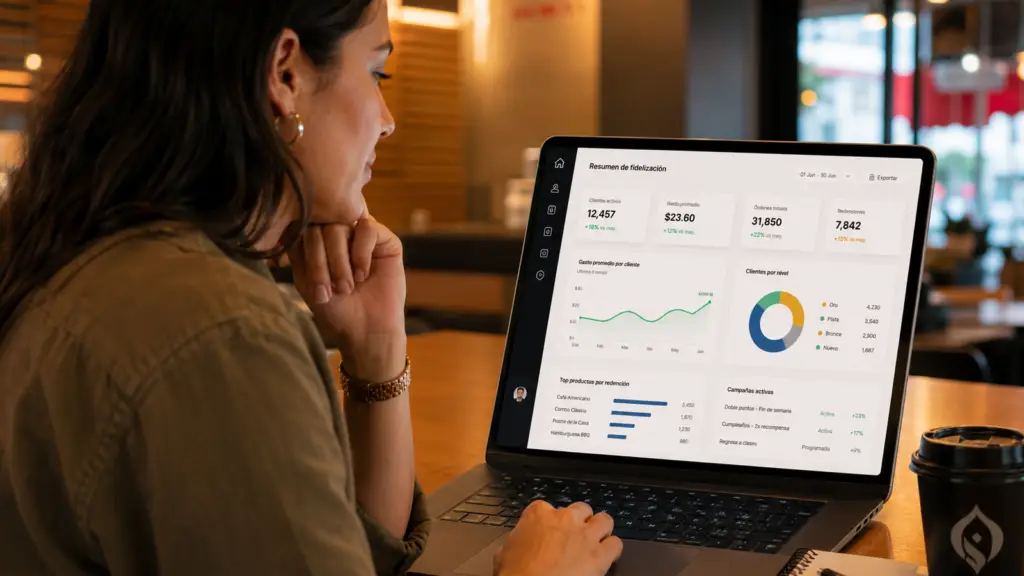

The RFM model is a customer segmentation method that analyzes three variables: Recency (how recently a customer purchased), Frequency (how often they buy), and Monetary Value (how much they spend). Applied to loyalty programs, RFM enables brands to prioritize marketing actions based on actual customer behavior — rather than treating every member the same.
What is the RFM Model and Why Does It Matter in Loyalty?
RFM stands for Recency, Frequency, and Monetary Value. The model was developed in the direct marketing industry in the 1990s and is built on a straightforward premise: customers who bought recently, buy often, and spend more are significantly more likely to respond to your campaigns.
In the context of a loyalty program, RFM transforms your member database from a list into an actionable asset. Instead of seeing ‘10,000 registered members,’ you see exactly who your brand ambassadors are, who is at risk of churning, and who has already gone silent.
Research in customer retention consistently shows that retaining an existing customer costs between 5 and 7 times less than acquiring a new one. RFM tells you precisely where to direct that retention effort — and where not to waste it.
The Three Dimensions of the RFM Model
Each variable adds a distinct lens to customer behavior:
Recency (R) — Measures how much time has passed since a customer’s last purchase. A guest who visited your restaurant three days ago is far more receptive to an offer than someone who hasn’t been in six months. Recency is consistently the strongest predictor of campaign response rates.
Frequency (F) — How many times a customer has purchased within a given period. A guest who visits your QSR chain twice a week has a fundamentally different relationship with your brand than someone who comes once a month, even if their per-visit spend is similar.
Monetary Value (M) — Total accumulated spend over the analysis period. This indicator helps you identify high-value customers: the segment where personalization and exclusive benefits generate the highest return on investment.
The power of RFM lies in combining all three dimensions. A customer with high recency, high frequency, and high monetary value is your star customer. One with high frequency but low value might be a strong candidate for an upsell campaign. RFM gives a name to those differences so you can act on them systematically.

How to Apply RFM Marketing in Your Loyalty Program
Implementing the model doesn’t require complex infrastructure — but it does require organized transactional data. The basic steps:
- Extract the purchase history from your loyalty platform or point-of-sale (POS) system for a defined period, typically the last 12 months.
- Assign a score from 1 to 5 to each customer across each dimension (R, F, M). A 5 reflects the most desirable behavior: bought yesterday, buys every week, spends the most.
- Combine the three scores to create an RFM profile. A ‘555’ customer is your champion; a ‘111’ is a lost customer.
- Group profiles into actionable segments: Champions, Loyal Customers, At-Risk, Recent Newcomers, Lost.
- Design specific campaigns for each segment: exclusive rewards for Champions, reactivation incentives for At-Risk customers, win-back offers for Lost ones.
A loyalty platform with built-in marketing automation can run these segmentations automatically — triggering a campaign the moment a customer falls into the ‘At-Risk’ category, without requiring your team to manually monitor the database.
Key RFM Segments for Restaurant Chains and Retail
While the model can theoretically generate up to 125 combinations (5³), QSR and retail operators typically work with five or six priority segments:
Champions (555) — Bought recently, buy frequently, and spend the most. These are your potential brand ambassadors. The goal is to recognize them, give them early access to new products, and activate them as active referrers.
Loyal Customers (X4X or X5X) — High frequency even if not always the highest ticket. They are the backbone of your customer base. The strategy is to keep them engaged through tiered benefits and personalized communication via channels like WhatsApp Business.
At-Risk Customers (2–3 in R, high in F and M) — They used to buy frequently but haven’t been seen in a while. This is often your highest-ROI opportunity: they already know your brand; they just need a compelling reason to return. A personalized, time-limited offer typically performs well here.
Promising Customers (4 in R, low in F and M) — Bought recently but haven’t yet formed a habit. This is the ideal moment to actively enroll them in your loyalty program and guide them toward their second and third purchase.
Lost Customers (1 in R, any F and M) — Haven’t purchased in a long time. Win-back campaigns for this segment have lower response rates, but the cost of attempting recovery is still lower than acquiring a net-new customer from scratch.

RFM and Data Intelligence: The Next Level
The RFM model becomes significantly more powerful when paired with a data intelligence layer. Platforms like Spoonity Intelligences allow brands to cross-reference RFM scores with demographic profiles, product preferences, and purchase channel data — enabling even more precise segmentation.
For example, knowing that your Champions purchase primarily on Friday evenings through your app — or that your At-Risk customers prefer to pay in cash in-store — completely changes the communication strategy and the channel through which you should reach them.
Brands like Krispy Kreme Mexico have demonstrated that combining transactional data with personalized segmentation strategies produces measurable results in retention and purchase frequency. According to Harvard Business Review, a 5% increase in customer retention can grow profits by 25% to 95%.
Frequently Asked Questions
RFM stands for Recency, Frequency, and Monetary Value. It is a segmentation model that classifies customers based on when they last purchased, how often they buy, and how much they spend. It is widely used in loyalty programs to prioritize marketing actions according to actual customer behavior.
Extract the transactional history from your POS or loyalty platform (typically the last 6 to 12 months), assign a score from 1 to 5 to each customer across the three dimensions, and combine them into a profile. Most loyalty platforms with Business Intelligence capabilities calculate this automatically from purchase data.
It depends on your industry and typical purchase frequency. For restaurant chains and QSR operators, where recurrence can be weekly, a monthly or even biweekly update is recommended. In retail with less frequent purchases, a quarterly review is generally sufficient.
Yes. Spoonity’s loyalty platform collects transactional data from each customer through integrations with leading point-of-sale systems — Oracle, NCR Aloha, PAR PixelPoint, and others — and allows brands to segment their customer base to design personalized campaigns. The Spoonity Intelligences tool provides the analytics layer needed to apply this type of segmentation at scale.
The RFM model isn’t a magic formula — but it is one of the most efficient frameworks available for moving beyond one-size-fits-all marketing. The sooner you start segmenting, the sooner you can concentrate your marketing budget on the customers who actually drive growth. If you want to see how Spoonity can help you implement RFM analysis across your chain, request a demo.