Loyalty marketing is a strategy that uses rewards, personalized communication, and customer data to increase purchase frequency, average spend, and long-term retention. When executed correctly, it transforms a standard loyalty rewards program from a simple points system into one of the most profitable channels in your marketing mix.
Why Most Rewards Programs Fail to Drive Revenue
Many restaurant chains and retail brands launch a customer loyalty program with high expectations — and end up with a database full of dormant members and marginal sales impact. The reason is almost always the same: they built a program, not a strategy.
A transactional rewards program — one that just assigns points to purchases — captures data but doesn’t act on it. Loyalty marketing, by contrast, uses that data to make customers feel recognized, trigger the right offer at the right moment, and turn a one-time visit into a habit. According to Bain & Company, increasing customer retention rates by just 5% increases profits by 25% to 95%. The difference between those two outcomes is almost always the quality of the marketing strategy behind the program.
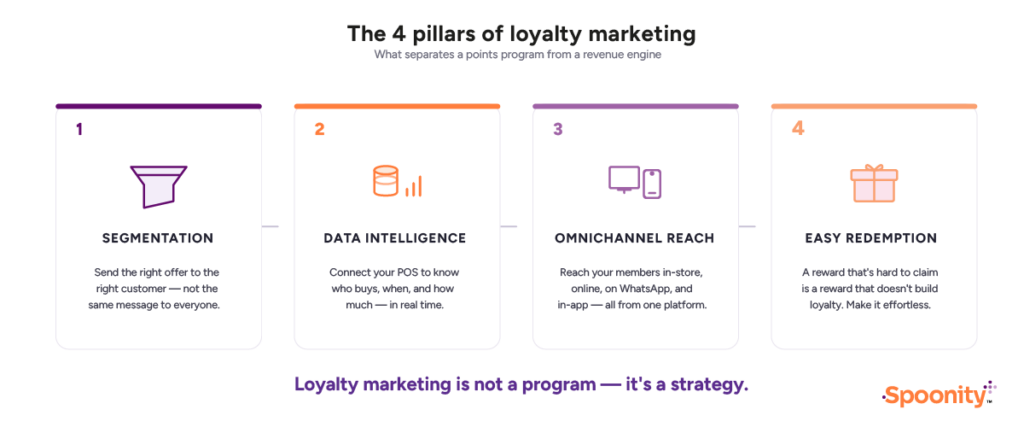
The 4 Pillars of High-Performing Loyalty Marketing
1. Segmentation Over Broadcasting
Generic promotions — “Get double points this weekend!” — generate short-term spikes but don’t build loyalty. Effective loyalty marketing segments your member base by visit frequency, average ticket, preferred product categories, and recency. A customer who visits twice a week needs a different message than one who hasn’t returned in 45 days.
This is where marketing automation becomes essential. Automated flows triggered by customer behavior — a win-back campaign for lapsed members, a birthday reward, a milestone unlock — outperform broadcast campaigns on every meaningful metric: open rate, redemption rate, and incremental revenue.
2. Data That Connects the Dots
Loyalty marketing only works when your program is connected to your point of sale. Without transaction-level data, you’re guessing. With it, you can calculate customer lifetime value (CLV), identify your top 20% of spenders, spot churn signals before they become churned customers, and measure the true ROI of every campaign.
Spoonity’s platform integrates natively with leading POS systems — including Oracle, NCR Aloha, and PAR PixelPoint — so every transaction feeds your loyalty intelligence layer in real time. This is what separates a data-driven loyalty strategy from a guesswork-based one.
3. Omnichannel Reach
Your customers don’t live in one channel. They order in-store, online, and through delivery apps. They check their points on a mobile app and respond to WhatsApp messages. Your loyalty marketing needs to follow them across all of those touchpoints consistently.
Brands that run omnichannel loyalty programs see significantly higher repeat purchase rates than those that operate a single-channel program. Reaching members through WhatsApp Business, push notifications, email, and in-app messaging — all tied to the same member profile — creates the kind of seamless experience that drives habit formation.
4. A Clear Path to Redemption
One of the most underrated friction points in loyalty programs is the redemption experience. If earning is easy but redeeming is confusing or restricted, members disengage. High-performing loyalty marketing designs the redemption flow as carefully as the earning mechanics — because a redeemed reward is proof that your program works, and proof creates advocacy.
QSR loyalty programs that offer flexible redemption (points for any item, not just specific SKUs) consistently outperform those with rigid catalogs. The goal is to make the reward feel like a genuine benefit, not a marketing gimmick.
Real-World Results: How Noodlebox Did It
Noodlebox, a Canadian restaurant chain with over 40 locations, partnered with Spoonity to build a loyalty marketing program connected to their digital ordering platform. The results — measured year-over-year — show what happens when strategy, data, and omnichannel execution come together:
- 126% increase in revenue from loyalty members
- 58.5% retention rate average across the program period
- 43.5% increase in new member registrations
- 14.2% year-over-year improvement in retention rate in 2023
These results didn’t come from a better points formula. They came from integrating loyalty data with ordering behavior, personalizing communication at scale, and making redemption effortless across every channel. You can read the full story in the Noodlebox case study.
What to Measure in Your Loyalty Marketing Program
A loyalty program without measurement is an expense. A loyalty marketing program with the right KPIs is a growth engine. Here’s what to track:
- Repeat purchase rate — The percentage of customers who return within a defined window. This is the most direct measure of program effectiveness.
- Customer lifetime value (CLV) — Average revenue per member over their relationship with your brand. Loyalty marketing should move this number up.
- Redemption rate — The percentage of earned rewards that are actually used. Low redemption signals disengagement or a poor reward catalog.
- Churn rate by segment — Track which member segments are leaving and when. Your win-back campaigns depend on catching this early.
- Campaign incremental revenue — Revenue attributable to loyalty marketing campaigns, separated from baseline sales. This is how you prove ROI to leadership.
Spoonity’s intelligence dashboard surfaces all of these metrics in real time, giving your marketing team the visibility to act quickly — not wait for a monthly report. Learn more about how the Spoonity Intelligence layer works.
Is Your Loyalty Program Ready to Become a Marketing Engine?
If your rewards program is running but your retention metrics aren’t moving, the issue usually isn’t the program itself — it’s the marketing strategy behind it. Loyalty marketing requires the right platform, the right data connections, and the right automation layer to deliver personalized experiences at scale.
Spoonity is a customer loyalty platform built specifically for restaurant chains, QSR operators, and multi-location retail brands. We don’t just launch programs — we design loyalty marketing strategies that are 100% customized to your brand, connected to your POS, and built to grow revenue over time.Ready to see what your program could look like as a revenue driver? Request a demo and talk to our team.
Frequently Asked Questions about Loyalty Marketing
A loyalty program is the infrastructure — points, rewards, a member database. Loyalty marketing is the strategy that activates that infrastructure: segmentation, automated campaigns, personalized communication, and data-driven decisions. The program is the tool; loyalty marketing is how you use it to grow revenue.
Track incremental revenue from members versus non-members, repeat purchase rates, and customer lifetime value over time. A well-run loyalty marketing program should show measurable improvement in all three within 90 days of launching structured campaigns. Spoonity’s intelligence dashboard is designed to surface exactly these metrics.
Restaurant chains and QSR operators see some of the highest loyalty marketing ROI because of high visit frequency and large transaction volumes. Retail and service businesses with repeat-purchase dynamics also benefit significantly. The key condition: your customer visits often enough that a loyalty relationship is meaningful — typically, at least once per month.
Spoonity integrates natively with the most widely used POS systems in the market, including Oracle, NCR Aloha, and PAR PixelPoint. See the full list of supported integrations.
Timelines depend on the complexity of your POS integration and the number of locations, but most brands are live within weeks — not months. Spoonity’s managed loyalty approach means our team handles the configuration, onboarding, and campaign strategy so yours doesn’t have to start from scratch.
Managed loyalty means Spoonity operates as your loyalty marketing partner — not just a software vendor. We configure the platform, design the rewards structure, build your segmentation strategy, and manage ongoing campaigns. It’s loyalty marketing as a service, built for brands that want results without building an in-house loyalty team. Learn more about managed loyalty.