
Marketing automation for restaurant loyalty programs allows chains to send personalized offers, trigger campaigns based on customer behavior, and track ROI — without manual effort. Platforms like Spoonity automate the full cycle: from onboarding new members to re-engaging churned customers across mobile, email, and WhatsApp.
What Is Marketing Automation in Loyalty Programs?
Marketing automation in loyalty programs is defined as the use of software to execute, manage, and optimize customer communications and rewards campaigns based on predefined rules or real-time behavioral data — with no manual intervention per campaign.
For restaurant chains, this means a customer who hasn’t visited in 30 days automatically receives a win-back offer. A member who just hit a reward threshold gets a congratulations push notification. A first-time buyer receives a welcome sequence — all without a marketing team manually triggering each action.
This is fundamentally different from batch-and-blast promotions. Automation responds to what customers actually do.
The Core Benefits of Marketing Automation for Loyalty
Higher retention without higher headcount. Automated re-engagement campaigns keep lapsed customers in the cycle. [STAT: insert verified industry stat on retention lift from automated loyalty campaigns here] Instead of reacting after churn, restaurants can set triggers that act before a customer goes cold.
Personalization at scale. A QSR chain with 50 locations can’t manually segment thousands of members. Automation makes it possible to send the right offer — a birthday reward, a location-specific promotion, a high-frequency customer upgrade — to the right person at the right moment. Spoonity’s

Automation makes it possible to send the right offer — a birthday reward, a location-specific promotion, a high-frequency customer upgrade — to the right person at the right moment. Spoonity’s marketing automation platform is built specifically for this: connecting purchase data to campaign logic so every message feels intentional, not generic.
Faster campaign execution. Campaign calendars that used to take days to build and QA can go live in hours. Marketing teams spend less time on execution and more on strategy.
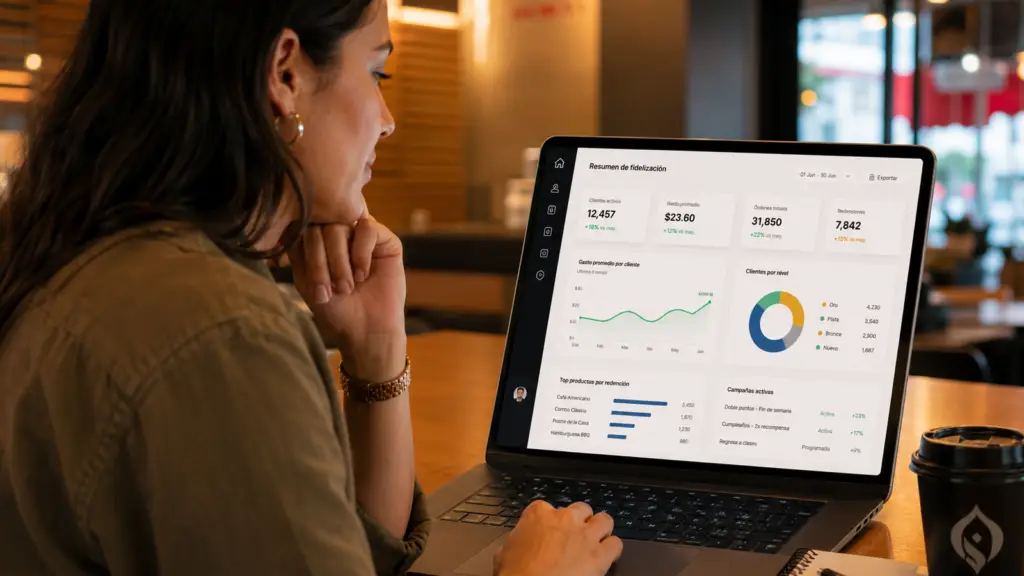
Measurable ROI per campaign. Every automated touchpoint generates data. Open rates, redemption rates, revenue per campaign — all trackable. This is the shift from marketing as a cost center to marketing as a measurable growth driver.
How Marketing Automation Works Inside a Loyalty Program
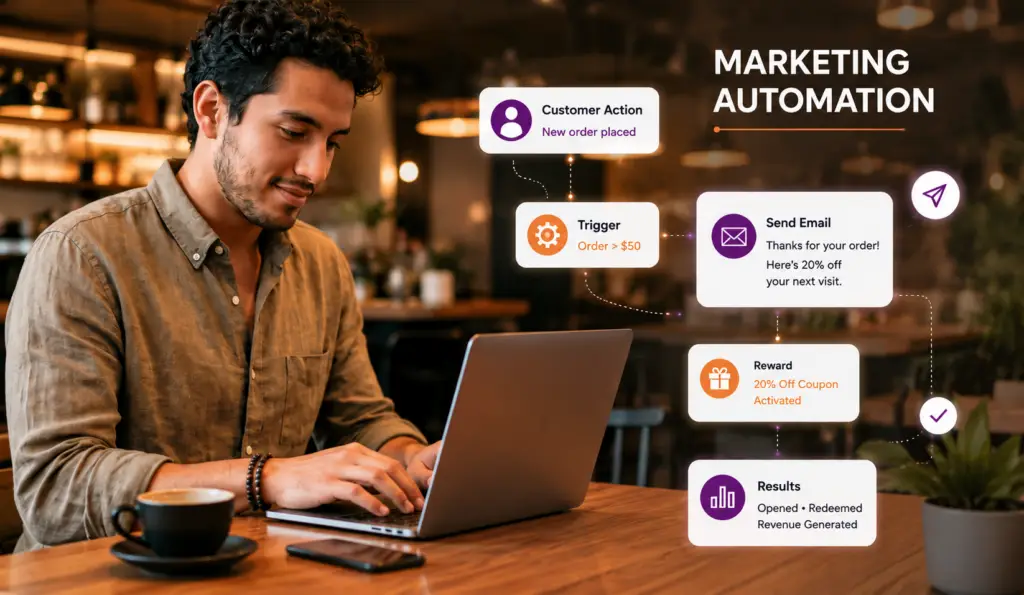
The engine behind automated loyalty marketing is behavioral triggers connected to a customer database. Here’s the basic flow:
- Customer action — a purchase, a sign-up, a period of inactivity, a birthday
- Trigger fires — the platform detects the event and matches it to a rule
- Message sends — via push notification, email, SMS, or WhatsApp
- Reward activates — points, discount, free item, or personalized offer
- Results logged — redemption, visit, revenue attributed to the campaign

Restaurants using Spoonity’s loyalty platform can layer this logic across every customer segment — from new members to VIPs — through a single dashboard that connects to their POS in real time.
The omnichannel component matters here. The benefits multiply when campaigns reach customers where they already are: in-app, on WhatsApp, via email. A customer who ignores a push notification might respond to a WhatsApp message the next morning.
Common Mistakes Restaurants Make Without Automation
Without automation, loyalty programs tend to fall into predictable traps:
One-size-fits-all promotions. When every customer receives the same offer regardless of behavior, high-value customers feel undervalued and low-engagement customers get discounts they’d never redeem anyway.
Research from McKinsey shows personalization can deliver 5–8x higher ROI on marketing spend compared to generic campaigns.
Delayed responses. Manual programs can’t react in real time. A customer who just placed their fifth order is at peak loyalty — if no reward triggers immediately, the moment passes.
No visibility on what works. Without automated tracking, it’s nearly impossible to know which campaigns actually drive repeat visits versus which just cost margin.Chains that invest in automated loyalty marketing eliminate these gaps — and the operational drag that comes with managing campaigns manually across multiple locations.
Frequently Asked Questions
It’s a system that automatically sends rewards, offers, and communications to loyalty members based on their behavior — without manual campaign management. When a customer reaches a point threshold, goes inactive, or celebrates a birthday, the platform triggers the right message at the right time.
By identifying at-risk customers early and triggering re-engagement campaigns before they fully lapse. Automated win-back sequences — a personalized offer sent after 30 days of inactivity, for example — recover customers who would otherwise be lost without any manual effort from the marketing team.
No. Automation delivers value at any scale, but the ROI accelerates as the customer database grows. Even chains with a few thousand loyalty members benefit from automated birthday campaigns, tier upgrades, and location-specific promotions that would be impossible to manage manually.
If your restaurant chain is running a loyalty program on manual effort, you’re leaving retention on the table. Automation doesn’t replace your marketing team — it removes the repetitive work so they can focus on what actually moves the needle. Request a demo to see how Spoonity automates loyalty campaigns for QSR chains across LATAM and North America.